
Indigenous Knowledge and Phytochemical Screening of Antihypertensive Plants in Benin with Evaluation of Larval Toxicity
-
Sèna Carine M.J. Aboua

Laboratory of Forest Studies and Research, BP 123, University of Parakou, Benin
Bienvenue Nawan K. SourouLaboratory of Forest Studies and Research, BP 123, University of Parakou, Benin
Adigla Appolinaire WédjangnonLaboratory of Forest Studies and Research, BP 123, University of Parakou, Benin
Christine A. I. N. OuinsaviDepartment of Natural Resource Management, Faculty of Agronomy, University of Parakou, Benin
| Received 31 Jan, 2026 |
Accepted 16 May, 2026 |
Published 30 May, 2026 |
Background and Objective: Due to the high cost of healthcare, several African countries are increasingly turning to medicinal plants as alternative therapies. In Africa, species such as Persea americana, Heliotropium indicum, Parkia biglobosa, Mangifera indica, and Newbouldia laevis are recognized for their antihypertensive properties; however, their phytochemical composition and toxicity profiles remain poorly documented. This study aimed to analyze the phytochemical composition and larval toxicity of five medicinal plants used for hypertension treatment in Benin. Materials and Methods: Plant samples were collected from the Baka experimental site (University of Parakou, Benin), dried, powdered, and extracted using aqueous maceration and decoction methods. Phytochemical screening was performed using standard qualitative tests, and larval cytotoxicity was evaluated using the Artemia salina assay. The LC50 values were determined by logarithmic regression analysis of dose-response data. Results: Phytochemical screening revealed the presence of several bioactive compounds, including tannins, flavonoids, anthocyanins, saponosides, and reducing compounds. The LC50 analysis indicated no significant toxicity at the tested concentrations, with values ranging from 0.42 to 1.18 mg/mL for Heliotropium indicum and Mangifera indica, respectively. Moreover, no toxic compounds, such as cardiotonic heterosides or cyanogenic derivatives, were detected. Conclusion: These findings suggest that the studied plant extracts have potential therapeutic value for hypertension management with a favorable safety profile. However, further quantitative phytochemical analysis and preclinical and clinical studies are required to confirm their efficacy and safety.
| Copyright © 2026 Aboua et al. This is an open-access article distributed under the Creative Commons Attribution License, which permits unrestricted use, distribution, and reproduction in any medium, provided the original work is properly cited. |
INTRODUCTION
Arterial Hypertension (AHT) is a widespread condition today, although it has long been perceived as a rare or even absent pathology in Africa. The prevalence of AHT in adults aged 25 and over in the global population was estimated at more than 27% in 20221,2. Estimates of hypertensive people could reach 1.56 billion people in 20251,3, an increase to be largely observed in low- and middle-income countries2. A very common and disabling disease, AHT impacts both men and women because it represents one of the leading causes of mortality linked to cardiovascular diseases in the world4,5. Cardiovascular diseases are chronic disorders of the cardiac system involving complex interactions with other body systems6. They can be associated with the respiratory, endocrine, renal and nervous systems4. Specific risk factors for cardiovascular diseases may include age, gender, obesity, diabetes, excessive alcohol and tobacco use, heredity, blood pressure, cholesterol, stress and depression1. Without a shadow of a doubt, there are a variety of well-known synthetic drugs for the treatment of AHT. However, this medication becomes distressing due to the expensive treatment in the long term7. Besides the economic implications and side effects of synthetic drugs5,8, the preference for herbal therapy may be justified by the low compliance of patients9 who have difficulty taking the recommended doses of modern drugs daily due to side effects.
The use of medicinal plants is a common and traditional practice in the world and especially in Africa10. This fact is more verifiable in developing countries in West Africa where more than 80% of the population depends on traditional medicine11. In the Republic of Benin, traditional healers and plant traders provide health coverage for the population at both rural and urban levels. A generalized ethnobotanical survey9 on medicinal plants that can prevent and treat HBP identified 5 (Persea americana, Heliotropium indicum, Parkia biglobosa, Mangifera indica and Newbouldia laevis) main plants according to the preference of local communities. Mainly administered orally, the leaves, fruits, seeds, roots, barks, etc., of these plants are known to contain phytochemical compounds1,12 (flavonoids, tannins, alkaloids, reducing compounds) and possess antihypertensive9, cardioprotective13, anti-inflammatory12, antioxidant, etc activities. However, few studies have addressed the increased risk of toxicity due to poor administration in low or high doses for the treatment of AHT on the 5 species of choice according to the preference of the indigenous Beninese populations.
This article focuses on highlighting the phytochemical potential and toxicity of these 5 plants of choice in the prevention and treatment of AHT in Benin through phytochemical screening and measurement of their larval toxicity.
MATERIALS AND METHODS
Study area and duration: For the preparation of aqueous extracts, samples of plant parts (Table 1) were collected from the Baka experimental site (9°18’47.1’’N, 2°42’07.7’’E) of the Faculty of Agronomy, University of Parakou, Republic of Benin, then dried at room temperature (33-35°C) in a dry, well-ventilated, dark place for one month. Each dried plant part was then transformed into a fine powder using an electric grinder, then preserved in a dry and hermetically sealed container to prevent contamination. This research was conducted between the period of October, 2024 and December, 2025.
Phytochemical characterization of medicinal plant species
Plant selection: The plant species included in this study were selected based on the results of an ethnobotanical survey9 of local communities in the Republic of Benin. The relative frequencies of citation made it possible to retain Persea americana Mill., Heliotropium indicum L., Parkia biglobosa (Jacq.) R.Br. ex G.Don, Mangifera indica L. and Newbouldia laevis (P.Beauv.) Seem. ex Bureau. The plants collected for this study were authenticated on the basis of regional botanical flora and by comparison with reference specimens available at the Benin National Herbarium.
Phytochemical screening of extracts: Qualitative phytochemical screening of aqueous extracts from different species (Table 1) was carried out14, based on coloring and/or precipitation reactions specific to the main groups of chemical compounds. Phytochemical screening and larval toxicity testing (Artemia salina larvae) were carried out in the Organic Chemistry and Pharmaceutical Chemistry Laboratory of the Faculty of Health Sciences in Cotonou, Benin.
| Table 1: | List of medicinal plants, their families, and plant parts used in the study | |||
| N° | Name of plant extract | Family | Organ used |
| 1 | Persea americana Mill. | Lauraceae | Leaves |
| 2 | Heliotropium indicum L. | Boraginaceae | Whole plant |
| 3 | Parkia biglobosa (Jacq.) R.Br. ex G.Don | Fabaceae | Bark |
| 4 | Mangifera indica L. | Anacardiaceae | Leaves |
| 5 | Newbouldia laevis (P.Beauv.) Seem. ex Bureau | Bignoniaceae | Leaves |
| Table 2: | Correspondance between LC50 et toxicity | |||
| LC50 | Toxicity |
| LC50≥100 μg/mL ou 0,1mg/mL | - |
| 100 μg/mL>LC50≥50 μg/mL | + |
| 50 μg/mL>LC50≥10 μg/mL | ++ |
| LC50<10 μg/mL | +++ |
| -: Non toxic, +: Weak, ++: Moderate abd +++: Strong | |
Preparation of crude extracts: For the preparation of aqueous extracts, 50 g of powder are dissolved in 500 mL of distilled water. The mixture is left to stir continuously for 72 hrs and the macerate obtained is filtered three times successively on hydrophilic cotton. Then, the filtrate obtained was placed in an oven at 40°C for 24 hrs to obtain the crude aqueous extract.
The decoction is made in the same proportions 1m/10v i.e. 50 g of powder in 500 mL of distilled water and the mixture is brought to a moderate boil on a hot plate for 30 min. Then, the decoction is filtered, evaporated and dried at 40°C.
The residues obtained are weighed to calculate the yield according to the following relationship:
Evaluation of larval cytotoxicity of extracts from different plant species: The toxicity assessment of organ extracts was carried out using the shrimp larvae survival test (Artemia salina) in seawater in the presence of extract solutions. This is a bioassay method used to assess preliminary toxicity in the context of the search for active natural substances. This test is very useful for knowing the degree of toxicity of plant extracts and is widely used in the literature15. For this work a colony of 16 larvae was used in each solution.
Preparation of test solutions: The aqueous extracts of the plants were prepared at an initial concentration of 50 mg/mL. We then proceeded to ten10 successive dilutions to half (1/2) of the stock solution with seawater. The concentrations expressed in mg/mL of the diluted solutions contained in test tubes numbered from 1 to 10 were, respectively 50/2; 50/4; 50/8; 50/16; 50/32; 50/64; 50/128; 50/256; 50/512 and 50/1024. The tests were repeated to ensure the fidelity of the results.
Determination de la LC50.
The LC50 lethal half-concentration values for the various extracts tested were determined using the expression15:
With β the y-intercept and α the directrix of the equation (y = alnx+β) of the logarithmic regression curve plotted on the sensitivity graph. These values express the concentrations necessary for the mortality of 50% of the larval population introduced into the extract solutions tested.
Data analysis: Phytochemical screening data were entered into an Excel spreadsheet and analyzed in tabular and graphical form. The dose-response data obtained from the toxicity test were log-transformed to determine the lethal concentration 50 (LC50) by linear regression16. To assess the level of toxicity from the LC50 valeurs, we used the correspondence scale (Table 2) established by16 and widely used in the literature15,17.
RESULTS AND DISCUSSION
Phytochemical composition of 5 plant species for therapeutic use against Arterial hypertension: Phytochemical compounds identified in the plant species used to treat arterial hypertension are summarised in Table 3. Regardless of the species, cardiotonic heterosides and cyanogenic derivatives were absent from the extracts. These compounds are generally known to be acutely toxic to heart failure patients.
Persea americana Mill. (Lauraceae): Avocado (Persea americana) leaf powder contains tannins, catechic tannins, gallic tannins, flavonoids, mucilages, reducing compounds, free anthracenics, coumarins, O-heterosides, and some traces of quinone derivatives.
Heliotropium indicum L. (Boraginaceae): Phytochemical screening carried out on the powder of the whole plant of Heliotropium indicum highlighted the following bioactive compounds: Gallic tannins, saponosides, triterpenoids, reducing compounds and O-heterosides.
Parkia biglobosa (Jacq.) R.Br. ex G.Don (Fabaceae): Phytochemical screening carried out on the powder of the bark of the trunk of Parkia biglobosa highlighted the following compounds : alkaloid, catechic tannins, gallic tannins, anthocyanins, leuco-anthocyanins, saponosides, reducing compounds and free anthracenics.
Mangifera indica L. (Anacardiaceae): Mangifera indica leaf powder contains: alkaloids, gallic tannins, flavonoids, anthocyanins, leuco-anthocyanins, mucilages, saponosides, reducing compounds and coumarins.
| Table 3: | Phytochemical screening of plant extracts showing detected metabolites and their relative presence | |||
| Metabolite samples | Detection tests/Reagents | 1 | 2 | 3 | 4 | 5 |
| Alkaloids | Mayer’s reagent | - | - | + | ++ | + |
| Tannins | 1% ferric chloride | + | + | + | + | - |
| Catechin tannins | Stiasny’s reagent | + | - | + | - | - |
| Gallic tannins | 1% ferric chloride, saturated with sodium acetate | ++ | ++ | ++ | + | - |
| Flavonoids | Shinoda test (hydrochloric alcohol + Mg powder) | ++ | - | - | ++ | ++ |
| Anthocyanins | 5% hydrochloric acid and 50% ammonia | - | - | + | ++ | ++ |
| Leucoanthocyanins | Shinoda reaction | - | - | ++ | + | - |
| Mucilages | Absolute alcohol test | + | - | - | + | + |
| Cyanogenic derivatives | Picric acid / HCN release | - | - | - | - | - |
| Saponosides | Foam index test | + | ++ | ++ | ++ | + |
| Triterpenoids | Liebermann–Burchard reagent | - | + | - | - | - |
| Steroids | Kedde reagent | - | - | - | - | - |
| Reducing compounds | Fehling's solution test | + | + | + | + | - |
| Cardiotonic heterosides | Kedde reagent | - | - | - | - | - |
| Coumarins | Ether and 25% ammonia | + | - | - | ++ | - |
| Free anthracenics | Chloroform and ammonia test | ++ | - | + | - | - |
| O-heterosides | Hydrochloric acid+chloroform+ammonia | ++ | + | - | - | - |
| C-heterosides | FeCl +chloroform+ammonia | - | - | - | - | + |
| Quinone derivatives | Born–Träger reagent | + | - | - | - | - |
| Proportion of presence (%) | 57.89 | 31.58 | 47.37 | 52.63 | 31.58 | |
| ++: Very positive reaction, +: Positive reaction and -: Negative reaction | ||||||
|
|
| Table 4: | Percentage yield of plant extracts | |||
| Extracts | Persea americana | Heliotropium indicum | Parkia biglobosa | Mangifera indica | Newbouldia laevis |
| Yield (%) | 6.08 | 8.72 | 5.43 | 12.48 | 10.22 |
Newbouldia laevis (P.Beauv.) Seem. ex Bureau (Bignoniaceae): Newbouldia laevis leaf powder contains: alkaloids, flavonoids, anthocyanins, mucilages, saponosides and C-heterosides.
Extraction yield: The mass percentage yield is calculated as the average of the two tests with the standard deviation. The values found are listed in Table 4.
The yield varies depending on the type of extract and the species studied. The highest yield is obtained with Mangifera indica (12.48%) against 5.43% minimum value for the plant Parkia biglobosa. Water being the main solvent used to carry out the extractions, we can say that all the species studied contain chemical principles which have an affinity with water, and therefore partly contain polar molecules.
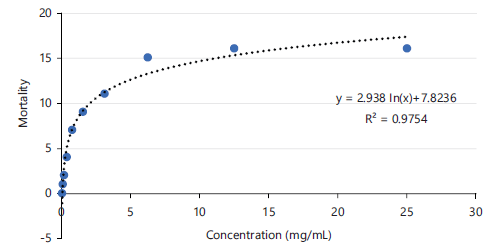
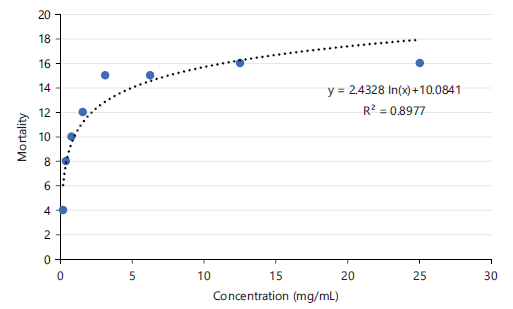
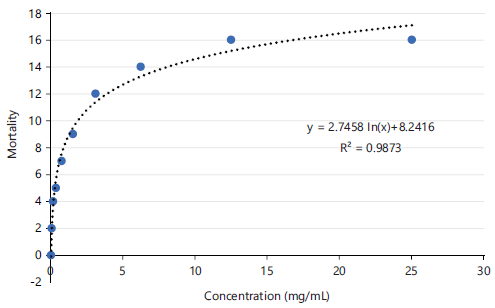
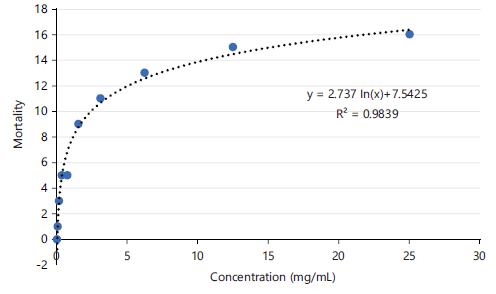
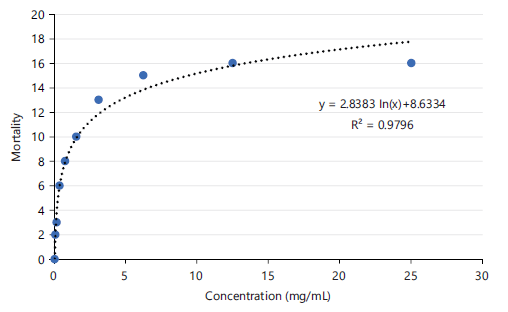
Cytotoxic activity of extracts: Based on the number of dead larvae recorded at the end of the test, we drew curves showing the variation in larval sensitivity as a function of extract concentration. These curves are shown in the Fig. 1-5 below.
We note for all the graphs obtained that the correlation coefficient R2 is greater than 0.8. There is therefore a good correlation between the concentrations applied and the responses obtained.
|
|
|
Furthermore, In addition, the larvae were sensitive to all the extracts tested. The number of dead larvae increases with the concentration, therefore the sensitivity of the larvae to the extracts follows a dose-response relationship. Different values found are summarized in Table 5.
| Table 5: | LC50 values of the tested plant extracts | |||
| Extracts | α | β | LC50 (mg/mL) |
| Persea americana | 2.938 | 7.8236 | 1.0618799 |
| Heliotropium indicum | 2.4328 | 10.081 | 0.4251161 |
| Parkia biglobosa | 2.7458 | 8.2416 | 0.915771 |
| Mangifera indica | 2.737 | 7.5425 | 1.1819361 |
| Newbouldia laevis | 2.8338 | 8.6334 | 0.799702 |
| α and β represent the intercept and slope of the logarithmic regression equation (y = α lnx+β) used for LC50 determination. LC50 (mg/mL) indicates the lethal concentration required to cause 50% mortality of Artemia salina larvaeWe | |||
Analysis of the LC50 values of the extracts tested, in relation to Table 5 of correspondence, allows us to say that the extracts tested do not present any toxicity in the range of concentrations analyzed, because LC50 values obtained are between 0.42 and 1.18 mg/mL respectively for the Heliotropium indicum and Mangifera indica extracts, which values are higher than the set limit (0.1 mg/mL).
The convergence between the absence of cytotoxicity and the screening results suggests that the safety of these extracts stems from the absence of hazardous chemical classes, such as cardiotonic glycosides and cyanogenic precursors, which are usually associated with undesirable biological responses15.
The abundance of bioactive compounds in plant extracts is an important indicator for the potential for biological activity against arterial hypertension (AHT). Secondary metabolites responsible for antihypertensive activity have been highlighted by several studies18,19. The present study highlighted the different phytochemicals and evaluated the toxicity of plant extracts Persea americana, Heliotropium indicum, Parkia biglobosa, Mangifera indica and Newbouldia laevis in the prevention and treatment of AHT.
Avocado tree or Persea americana is an edible fruit tree used in traditional medicine and cosmetics20. Leaves of this species contains various phytochemical compounds namely: gallic tannins, flavonoids, mucilages, saponosides, reducing compounds, coumarins, free anthracenic and O-heterosides. Heliotropium indicum is a herbaceous plant containing mainly gallic tannins, saponosides, triterpenoids, reducing compounds, O-heterosides. Considered as a weed by several people, Heliotropium indicum is an erect or spreading annual herbaceous plant found in most plant formations12. The mango tree is a multi-purpose tree21. It is a fruit tree whose leaf powder contains: alkaloids, gallic tannins, flavonoids, anthocyanins, leucoanthocyanins, mucilages, saponosides, reducing compounds and coumarins. Parkia biglobosa is known for the multiple uses (medicine, fodder, fiber, food and drink, timber) of these organs by indigenous African populations Phytochemical screening of trunk bark powder highlighted the following compounds: Alkaloids, catechic tannins, gallic tannins, anthocyanins, leucoanthocyanins, saponosides, reducing compounds and free anthracenic compounds. Newbouldia laevis is a tree with therapeutic use in traditional medicine22. The powdered leaves of this species contains: alkaloids, flavonoids, anthocyanins, mucilages, saponosides, C-heterosides.
The majority of molecules identified were present in the identified species. Chemical compounds found in most plant extracts are gallic tannins, flavonoids, alkaloids, saponosides, reducing compounds and anthocyanins. Flavonoids are known for their ability to dilate blood vessels and inhibit adrenergic receptors23, proteins that can regulate cardiovascular functions. Tannins in general are polyphenolic compounds that prevent and stop bleeding and fight infections24. The presence of tannins in medicinal plants has proved their effectiveness25 antioxidant20, anti-inflammatory and antihyperglycemic. The antioxidant activity of a plant has the ability to prevent the deposition of fat in arteries. The antioxidant activity of our plant extracts could be explained by the abundance of polyphenolic substances such as tannins, flavonoids, anthocyanins having the capacity to trap free radicals that play a role in the condition of AHT, especially atheroma leading to atherosclerosis26. Flavonoids have demonstrated their ability to prevent cardiovascular diseases thanks to the antioxidant activity of plant extracts. Tannins present in plant xtracts have properties that promote circulation in small blood vessels, strengthening venous tone, increasing capillary resistance and stabilizing collagen. Tannins are also known for their analgesic and anti-inflammatory effects and their ability to reduce and maintain systolic and diastolic blood pressure. The presence of saponins in each extract demonstrates plants’ capacity for antimicrobial and anti-inflammatory defense system27.
Given the observed relationship between cytotoxic effects on shrimp larvae and on KB cells (human nasopharyngeal carcinoma) as well as A-549 lung carcinoma and HT-29 colon cancer cells, it may be inferred pending additional studies that the tested extracts do not exhibit significant cytotoxic activity28. Cases of cytotoxicity associated with phytotherapeutic substances used since ancient times and widely documented among populations are rarely reported in the clinical literature. The safety of the extracts from each plant is confirmed by the results of phytochemical screening, revealing the absence of cardiotonic heterosides, cyanogenic derivatives and quinonic derivatives, generally recognized as toxic compounds23,29. The correlation coefficient R2 following each plant extract was greater than 0.8, indicating a good relationship between the applied concentrations and the observed responses. This shows that the sensitivity of the larvae to the tested extracts increases with the number of dead larvae as the LC50 concentration increases. The different values of half-lethal concentrations LC50, represent the concentrations necessary to ensure the survival of 50% of the larval population exposed to each plant extract tested. The plant extract Heliotropium indicum showed a low LC50, which was less toxic than the extract of Mangifera indica leaves, which recorded the highest LC50value, proving the usefulness of respecting the dose for the consumer.
Although initial pharmacological studies provide encouraging evidence, confirmation through strictly controlled clinical protocols remains essential. However, the implementation of such research is hampered by significant financial constraints and difficulties specific to translational research, which currently limits the practical application of these findings in medical practice. In this context, it is essential to continue and deepen investigations in order to better understand the therapeutic and preventive potential of plant-based resources. A more in-depth analysis of these five plants would contribute to improving the management of high blood pressure through scientifically validated phytotherapeutic approaches.
CONCLUSION
Phytochemical screening of Persea americana, Heliotropium indicum, Parkia biglobosa, Mangifera indica, and Newbouldia laevis revealed the presence of diverse bioactive compounds, including tannins, flavonoids, anthocyanins, and saponosides. Larval toxicity assessment using Artemia salina showed LC50 values ranging from 0.42 mg/mL (Heliotropium indicum) to 1.18 mg/mL (Mangifera indica), indicating low toxicity. No cardiotoxic heterosides or cyanogenic compounds were detected. These results support the potential therapeutic use of these plants in traditional hypertension management and suggest a favorable safety profile, while further quantitative analyses and preclinical studies are needed to confirm their efficacy.
SIGNIFICANCE STATEMENT
This study provides scientific evidence supporting the traditional use of these five medicinal plants in hypertension management in Benin. By confirming the presence of bioactive compounds and LC50 values within safe ranges, it highlights their potential as safe, natural alternatives or complements to conventional antihypertensive therapies and lays the groundwork for future pharmacological studies.
FUNDING
This study was funded from Canada’s International Development Research Center (IDRC) under project number 109799-001, titled: « Strengthening Gender Inclusion in Agricultural Research for More Promising Results in West Africa (RIGRA).
REFERENCES
- Aumeeruddy, M.Z. and M.F. Mahomoodally, 2020. Traditional herbal therapies for hypertension: A systematic review of global ethnobotanical field studies. S. Afr. J. Bot., 135: 451-464.
- WHO, 2022. Monitoring Progress in the Fight Against Non-Communicable Diseases 2022 [In French]. World Health Organization, Geneva, Switzerland, ISBN: 9789240050129, Pages: 233.
- Kearney, P.M., M. Whelton, K. Reynolds, P. Munter, P.K. Whelton and J. He, 2005. Global burden of hypertension: Analysis of worldwide data. Lancet, 365: 217-223.
- Roth, G.A., G.A. Mensah, C.O. Johnson, G. Addolorato and E. Ammirati et al., 2020. Global burden of cardiovascular diseases and risk factors, 1990-2019: Update from the GBD 2019 study. J. Am. Coll. Cardiol., 76: 2982-3021.
- Al Disi, S.S., M.A. Anwar and A.H. Eid, 2016. Anti-hypertensive herbs and their mechanisms of action: Part I. Front. Pharmacol., 6.
- Bennett, J.E., G.A. Stevens, C.D. Mathers, R. Bonita and J. Rehm et al., 2018. NCD countdown 2030: Worldwide trends in non-communicable disease mortality and progress towards sustainable development goal target 3.4. Lancet, 392: 1072-1088.
- Diop, E.A., E.F. Queiroz, S. Kicka, S. Rudaz, T. Diop, T. Soldati and J.L. Wolfender, 2018. Survey on medicinal plants traditionally used in Senegal for the treatment of tuberculosis (TB) and assessment of their antimycobacterial activity. J. Ethnopharmacol., 216: 71-78.
- Susalit, E., N. Agus, I. Effendi, R.R. Tjandrawinata, D. Nofiarny, T. Perrinjaquet-Moccetti and M. Verbruggen, 2011. Olive (Olea europaea) leaf extract effective in patients with stage-1 hypertension: Comparison with Captopril. Phytomedicine, 18: 251-258.
- Aboua, S.C.M.J., T. Houètchégnon, B.N.K. Sourou, A.A. Wédjangnon, G. Azongnidé and C.A.I.N. Ouinsavi, 2024. Diversity of plant species with ethnomedicinal potential for treating arterial hypertension and gastric ulcers, two chronic diseases: An ethnobotanical assessment in Benin. Ethnobotany Res. Appl., 29.
- WHO, 2013. WHO Strategy for Traditional Medicine 2014-2023 [In French]. World Health Organization, Geneva, Switzerland, ISBN: 9789242506099, Pages: 75.
- Adomou, A.C., B. Sinsin and L.J.G. van der Maesen, 2006. Notulae florae beninensis 12: Phytosociological and chorological approaches to phytogeography: A meso-scale study in Benin. Syst. Geogr. Plants, 76: 155 -178.
- Adetuyi, B.O., O.A. Adebisi, E.H. Awoyelu, O.A. Adetuyi and O.O. Ogunlana, 2021. Phytochemical and toxicological effect of ethanol extract of Heliotropium indicum on liver of male Albino rats. Lett. Appl. NanoBioSci., 10: 2085-2095.
- Gandonou, D.C., H. Ahissou, J.M. Tokoudagba and C. Dansou, 2017. Ethnobotanical, phytochemical and toxicity analysis of a beninese antihypertensive plant: Lippia multiflora. Int. J. Biol. Chem. Sci., 11: 1816-1828.
- Houghton, P.J. and A. Raman, 1998. Chromatographic Procedures using Columns and Liquid-Liquid Systems. In: Laboratory Handbook for the Fractionation of Natural Extracts, Houghton, P.J. and A. Raman (Eds.), Springer, Boston, MA, ISBN: 978-1-4615-5809-5,m pp: 82-93.
- Houngbeme, A.G., C. Gandonou, B. Yehouenou, S.D.S. Kpoviessi, D. Sohounhloue, M. Moudachirou and F.A. Gbaguidi, 2014. Phytochemical analysis, toxicity and antibacterial activity of Benin medicinal plants extracts used in the treatment of sexually transmitted infections associated with HIV/AIDS. Int. J. Pharm. Sci. Res., 5: 1739-1745.
- Meyer, B.N., N.R. Ferrigni, J.E. Putnam, L.B. Jacobsen, D.E. Nichols and J.L. McLaughlin, 1982. Brine shrimp: A convenient general bioassay for active plant constituents. Planta Med., 45: 31-34.
- Ombouma, J.G., A.J.A. Mebale, D.D.M. Abessolo, O.A. Mve and R. Mboma, 2022. Phytochemical screening, total polyphenols and flavonoids content and antiradical activity of methanolic extract of Lannea welwitschii (Hiern) Engl. (Anacardiaceae) from Gabon. Int. J. Biol. Chem. Sci., 16: 308-314.
- Darkwah, W.K., D.A. Koomson, N. Miwornunyuie, M. Nkoom and J.B. Puplampu, 2020. Review: Phytochemistry and medicinal properties of Solanum torvum fruits. All Life, 13: 498-506.
- Jain, T., D. Dubey, V. Jain and K. Dashora, 2021. Regulatory status of traditional medicines in different countries: An overview. Res. J. Pharm. Technol., 4: 1007-1015.
- Akrofi, S.A., 2024. Anti-hypertensive effect of ethanol extracts of Persea americana (avocado pear) leaf and seed on Wistar rats. Res. Square.
- Kajjari, S., B.K. Vanishree, S. Janardhanan, V.H. Patil, C. Uppin and S.M. Hugar, 2024. Antimicrobial efficacy of Mangifera indica, Mentha arvensis, and chlorhexidine mouthwashes on Streptococcus mutans and Candida albicans in children: A comparative in vivo study. Int. J. Clin. Pediatr. Dent., 17: S78-S83.
- Olounlade, P.A., M.S. Hounzangbe-Adote, E.V.B. Azando, T.B.T. Ha and S. Brunet et al., 2011. In vitro study of the effect of tannins from Newbouldia laevis and Zanthoxylum zanthoxyloides on the migration of Haemonchus contortus infective larvae [In French]. Int. J. Bio. Chem. Sci., 5: 1414-1422.
- Stéphane, W.A.A., O.T. Victor, A.N.E. Joël and N. Koffi, 2019. Ethnobotanical study of plants used in traditional medicine in the treatment of arterial hypertension in peoples of Divo department, (Center-West, Côte d’Ivoire) [In French]. Eur. Sci. J., 15: 384-407.
- Obafemi, T.O., M.T. Olaleye and A.C. Akinmoladun, 2019. Antidiabetic property of miracle fruit plant (Synsepalum dulcificum Shumach. & Thonn. Daniell) leaf extracts in fructose-fed streptozotocin-injected rats via anti-inflammatory activity and inhibition of carbohydrate metabolizing enzymes. J. Ethnopharmacol., 244.
- Sarkar, C., M. Mondal, B. Khanom, M.M. Hossain and M.S. Hossain et al., 2021. Heliotropium indicum L. from farm to a source of bioactive compounds with therapeutic activity. Evidence-Based Complementary Altern. Med., 2021.
- Drioiche, A., S. Amine, S. Boutahiri, S. Saidi and A. Ailli et al., 2020. Antioxidant and antimicrobial activity of essential oils and phenolic extracts from the aerial parts of Ruta montana L. of the Middle Atlas Mountains-Morocco. J. Essent. Oil Bear. Plants, 23: 902-917.
- Togola, I., Y. Kaya, N. Diarra, M.A. Konare, A. Denou and R. Sanogo, 2020. Comparative study of the phytochemistry and antioxidant activity of Anacardium occidentale (L.) leaf and stem bark extracts. J. Dis. Med. Plants, 6: 72-76.
- Pelka, M., C. Danzl, W. Distler and A. Petschelt, 2000. A new screening test for toxicity testing of dental materials. J. Dentist., 28: 341-345.
- Nguélé, O., N.N. Martin, B. Hervé, N. Joel and N.M.H. Julien, 2021. Phytochemical characterization and evaluation of the antihypertensive activity of extracts from Annona muricata Linn (Annonaceae) leaves [In French]. Health Sci. Dis., 22: 1-7.
How to Cite this paper?
APA-7 Style
Aboua,
S.M., Sourou,
B.N., Wédjangnon,
A.A., Ouinsavi,
C.A. (2026). Indigenous Knowledge and Phytochemical Screening of Antihypertensive Plants in Benin with Evaluation of Larval Toxicity. International Journal of Biological Chemistry, 20(1), 13-22. https://doi.org/10.3923/ijbc.2026.13.22
ACS Style
Aboua,
S.M.; Sourou,
B.N.; Wédjangnon,
A.A.; Ouinsavi,
C.A. Indigenous Knowledge and Phytochemical Screening of Antihypertensive Plants in Benin with Evaluation of Larval Toxicity. Int. J. Biol. Chem 2026, 20, 13-22. https://doi.org/10.3923/ijbc.2026.13.22
AMA Style
Aboua
SM, Sourou
BN, Wédjangnon
AA, Ouinsavi
CA. Indigenous Knowledge and Phytochemical Screening of Antihypertensive Plants in Benin with Evaluation of Larval Toxicity. International Journal of Biological Chemistry. 2026; 20(1): 13-22. https://doi.org/10.3923/ijbc.2026.13.22
Chicago/Turabian Style
Aboua, Sèna Carine, M.J., Bienvenue Nawan K. Sourou, Adigla Appolinaire Wédjangnon, and Christine A. I. N. Ouinsavi.
2026. "Indigenous Knowledge and Phytochemical Screening of Antihypertensive Plants in Benin with Evaluation of Larval Toxicity" International Journal of Biological Chemistry 20, no. 1: 13-22. https://doi.org/10.3923/ijbc.2026.13.22

This work is licensed under a Creative Commons Attribution 4.0 International License.
